Summer reading list 2022
05/08/2022
We would like to share with you our Summer 2022 reading list!
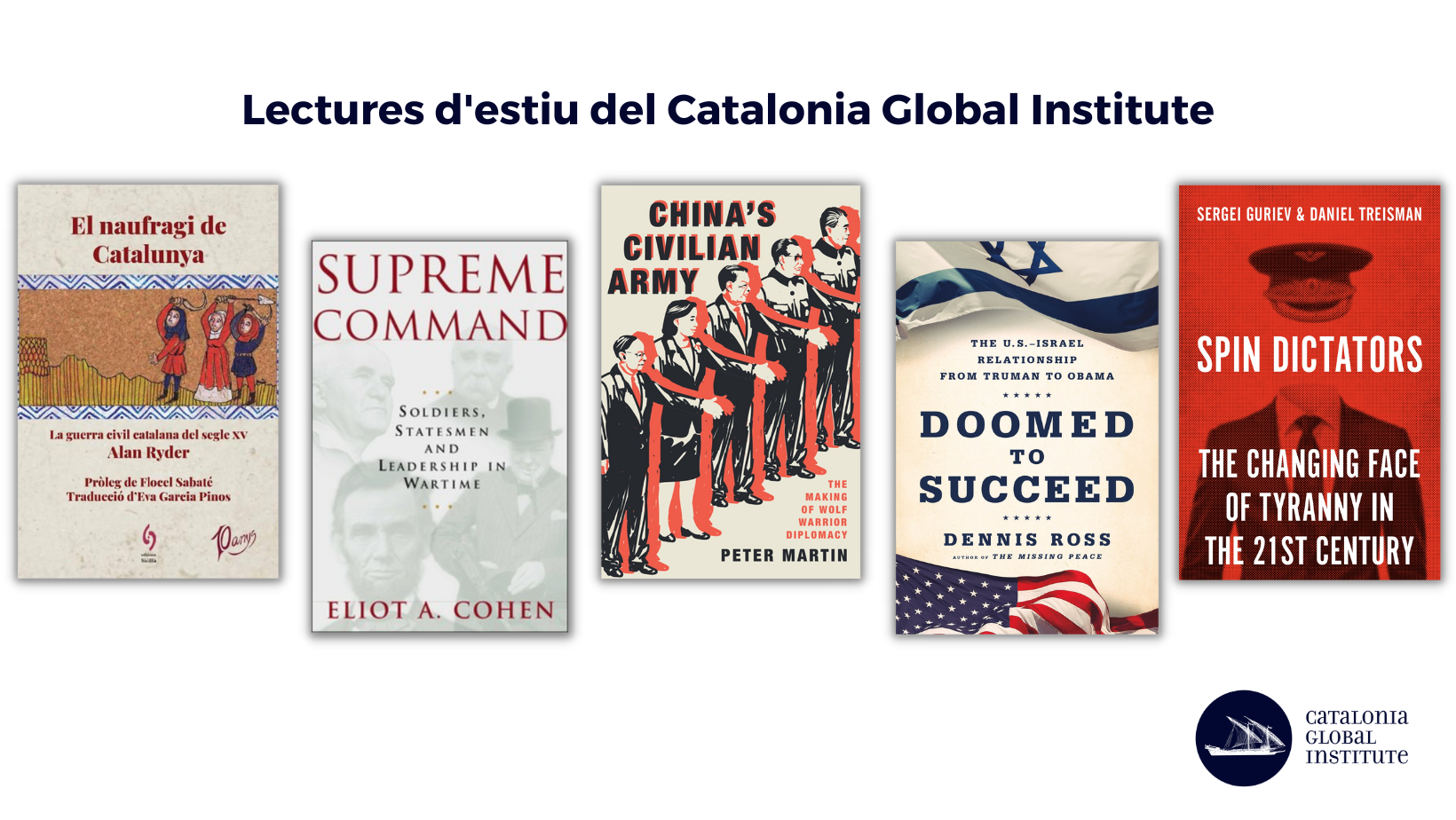
Doomed to succeed – Dennis Ross
The strategic alliance between the United States and Israel is considered so natural that, in the eyes of many people, it may seem that it has always existed. However, Dennis Ross’s “Dommed to succeed” shows us in detail that the path to establishing this relationship was not easy, let alone quick. Starting with recognition of Israel’s declaration of independence – which was a personal decision by Truman taken against the State Department’s criteria – that did not bring any economic or military support, going through Eisenhower’s hostile policy, Ross analyzes how Kennedy and subsequent administrations, with severe difficulties in the cases of some of them and always with the frontal opposition of the National Security establishment, paved the way for the formalisation of a formal strategic alliance culminating in the Reagan presidency. “Doomed to succeed” also discusses how, once the strategic alliance has been consolidated, several episodes and disagreements have strained the relationship between the United States and Israel, constantly testing it. It is a must for anyone who wants to understand the complex nature of relations between the United States and Israel.
Spin Dictators: The Changing Face of Tyranny in the 21st Century– Sergei Guriev and Daniel Treisman
In the past, thinking about how governments have imposed their authority, the images that come to our minds were related to physical punishment. Security forces, torture, or military interventions. Today, however, thanks to the development of communication technologies, openly authoritarian governments – and not so openly – are imposing their rule by controlling public discourse. A subtle but constant tool that turns out to be more effective, cheap, and legitimate in the eyes of citizens.
El Naufragi de Catalunya. La Guerra Civil Catalana del segle XV – Alan Ryder
This book tells one of the darkest episodes in Catalonia’s history. Alan Ryder reflects on how Catalonia went from being the hegemonic power in the Mediterranean to a period of decline that led to its submission to Castile. With exhaustive work, this book identifies historical trends of Catalan political culture that can help to understand the roots of many of today’s problems in Catalonia.
China’s Civilian Army: The Inside Story of China’s Quest for Global Power – Peter Martin
The Qing Empire was the center of its world until the system of Sinocentric relations that had prevailed in East Asia for centuries collapsed after the emergence of Western powers. Then China had to deal with unfamiliar diplomatic practices of the concert of European nations. But just as Chinese diplomacy began to make its early steps, the country experienced its most important historical turn, the arrival of the Chinese communist party of Mao Zedong. To build the diplomatic corps of the Chinese People’s Republic from scratch, Zhou Enlai used the most reliable tool he had at hand, the People’s Liberation Army. But the veterans of the Chinese revolution were not used to subtleties and codes of diplomacy but the harshness of the battlefield. In this book, Peter Marin explains the origins of the diplomacy of the Chinese Communist Party, through key episodes of the PRC’s history, such as the Cultural Revolution, Nixon’s visit and entry to the United Nations, to the present day with the so-called “Wolf-Warriors.”
Supreme Command: Soldiers, Statesmen, and Leadership in Wartime – Eliot A. Cohen
A healthy civil-military relationship is vital to achieving strategic victory in times of war but also for the appropriate functioning of a democracy. Eliot A. Cohen skillfully exposes the interaction between the military establishment and the civil government. He does so by exploring four examples of statesmen: Abraham Lincoln, Georges Clemenceau, Winston Churchill, and David Ben-Gurion. Cohen makes a strong case for the “unequal dialogue” between political and military leaders. In democratic states, despite tensions during the war, political leaders possess the authority to issue a final decision.