The Draghi Report, 2 Years On: EU competitiveness and the crawling execution of an insufficient proposal

18/09/2026
You can download the PDF version HERE.
“We appear to be sleepwalking, and Draghi already warned us that this will lead to slow agony. I think that was wrong. It’s not going to be slow.”
João Cotrim de Figueiredo, Portuguese MEP – quoted by H. Foy, FT, 15/7/2026
The politics of a historical report
In September 2024, amid media praise and fanfare, came out the so-called “Draghi report” —formally the report on The Future of European Competitiveness[i] led by Mario Draghi, former ECB President and Italian ex-Prime Minister, for the European Commission (EC). Given its topic’s high relevance as well as the boldness of its recommendations, and despite the very visible support the EC provided to it, this doubtlessly high-quality report was always bound to face some pushback. Yet above and beyond standard challenges, four major sources of criticism surfaced[ii]:
- Centralisation land grab: The report’s recommendations almost invariably called for centralized public policies, when often the issues it identified were more likely due to insufficient laissez-faire liberalisation.
- Huge recommended expense backed by too little cost-benefit analysis: The annual budget it recommended for these measures was enormous (estimated at close to 5% of the EU’s GDP), yet no quantitative evidence was provided to prove that these funds would yield more value if spent in these policies instead of being left in private hands.
- Low liberalisation/deregulation emphasis: While the report acknowledged the need for liberalisation, most of its recommendations targeted regulatory standardisation across countries as opposed to liberalisation along the lines of the US system whose performance the report aimed to replicate in the EU.
- Geographical blindside: The report studied the EU as a homogeneous block, despite its geographical disparities in terms of economic performance and institutional quality, and therefore failed to acknowledge the latter’s impact as a cause for the squandering of billions in previous transfer programmes (think for example of the Bulgarian mafia’s EU funds’ diversion scandals[iii])
These issues could not possibly result from inertia carried forward from previous studies: many high-quality reports on Europe’s competitiveness, say, by the World Bank[iv] or the World Economic Forum[v], were issued years before Draghi’s report came out but never fell into any of these three traps —and there is no question that Mario Draghi and his team must have studied them thoroughly. Draghi’s different approach is not due either to Europe somehow being particularly receptive to his recommendations: for example, Christian Lindner, then Germany’s Finance Minister, famously rejected Draghi’s plan within three hours of its being made public[vi] —so it was not exactly pushing an open door. The reason for this difference must (as many analysts hinted at the time) be related to the main feature Draghi’s report did not share with those well-known, widely-studied previous ones: it was ordered and financed by the EC.
Why would this matter? First because the EC, just like every other institution, is composed of human beings who benefit from the institution’s power and resources and in whose interest is therefore to expand it. Hence, as any good salesman would, the EC took a well-known, deeply concerning issue (Europe’s gradual loss of competitiveness) and commissioned almost simultaneously two reports from highly reputed, retired public figures (Mario Draghi and Enrico Letta) to advocate solutions entailing, among other points, further empowering the EC. This, per se, does not necessarily mean that the recommendations are wrong, but that their correctness (and particularly that of Draghi’s report, which is by far the most comprehensive and well structured) hinges on how well, or not, the analysis justifies the otherwise foregone conclusions for which the EC ordered them in the first place. Hence, the fact that the report’s justification for this centralising power grab is so weak constitutes prima facie evidence against it.
Even more revealing is, perhaps, the strange geographical blindness that afflicts both the Draghi and Letta reports. Geographical comparison being central to the best of the previous reports mentioned, the omission cannot possibly be just accidental. Yet, in a European Union where effective power ultimately belongs to the member states, it would have been suicidal for the report to antagonise any of them by singling them out or, even worse, by acknowledging that the institutional quality of some of them may not provide enough assurance that the funds handed over to them will be put to their intended use. Instead, the mechanism Draghi’s report, in particular, seems to advocate is the one followed with the Next Generation EU programme: raising funds for certain purposes through EU-backed debt and handing them over to the member states to spend, subject to very weak processes to monitor and punish lack of compliance.
None of these caveats imply that the report’s recommendations are wrong: on the contrary, they are for the most part necessary measures that, if implemented, will doubtlessly contribute to addressing the competitiveness issue that the EU has been dragging for decades, and that has systematically led the EU’s GDP to grow slower than not just China but also the US. The issue is that, due to its political biases, the plan is already grossly insufficient and, for all its declared ambition to catch up with the US, devotes surprisingly little room to fostering private initiative and competition, which are key across the Atlantic.
The report, in a nutshell
Before we move on, we must recall what the report actually said.
The Draghi report started with a compelling call for action: Europe as a whole has steadily been losing income per capita respective to the US since the early 1990s. It noted, for example, that, from 2002 to 2023, the US-EU gap in GDP per capita on a purchasing power parity (PPP) basis grew from 31% to 34% despite fast central and eastern European growth, and around 70% of this decline is explained by lower productivity in the EU13. To stop and revert the trend, it recommended a set of actions focused on the following three core areas:
- Most importantly, according to the report itself, Europe must collectively focus on closing the innovation gap with the US and China, especially in advanced technologies.
- In addition, Europe must invest to bring down its currently very high energy prices while continuing to decarbonise and shift to a circular economy.
- Finally, Europe must respond to increasingly uncertain geopolitics, so it no longer has to rely on others for its security.
The report then based its recommendations on the following four action areas:
- Full implementation of the goods, services, capital and labour Single Market.
- Europe-wide industrial, competition and trade policies (intended to be centrally designed and coordinated instead of fragmented by country).
- Massive investment: raise the total investment-to-GDP rate by around 5% of EU GDP per year (i.e. more or less like financing another Next Generation EU programme every year).
- EU governance reform aimed at deepening coordination and reducing regulatory burdens (e.g. centralising coordination and budget, easing consensus requirements, preventing local rule “gold plating”, allowing to move faster to those Member States willing to do so…).
Within this context, the report listed a set of recommendations, with a number of specific measures beneath each one of them, adding up to a total of 383 measures across ten economic sectors. Thus, far from being a high-level exercise, the Draghi report was designed to be executable and, furthermore, for its execution to be quantitatively tracked. So, from this perspective, how has it fared so far?
Where the rubber (slowly) meets the road
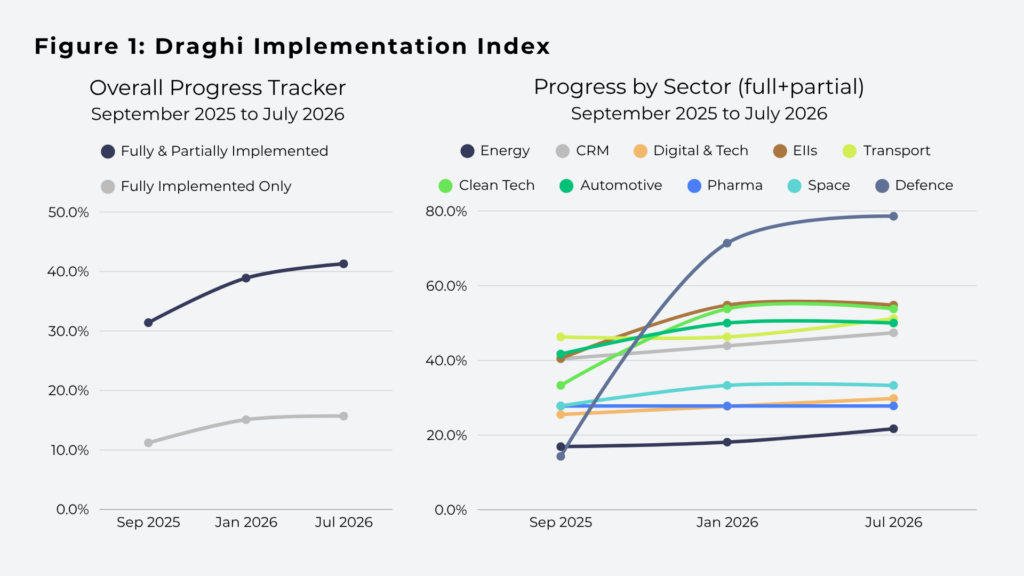
The answer is rather disappointing. The European Commission issued a first progress report[vii] in September 2025, a year after the report’s publication, and since then the European Policy Innovation Council (EPIC), a nonprofit think tank, has been tracking the execution of those 383 recommended measures. According to the EPIC July 2026 report[viii], only 60 measures (i.e. a 15.7% of the total) have been fully implemented, and another 98 (i.e. 25.6%) have been partially implemented.
Dismal as these statistics may seem, they actually get worse when we dive into the details. First because by September 2025 already 11.2% of the measures had been fully implemented and another 20.2%, which means that, after all the low hanging fruit were taken in the first year, just an additional 4.5% have been completed and another 9.9% have reached partial completion (Figure 1, left). Second, and even more concerningly, because for the last year, and most particularly since January 2026, nearly all the progress has been made in the Defence sector (Figure 1, right).
Even these metrics by themselves do not convey the full extent of the issue. We ought to remember that the most important area where the EU should seek improvement was, according to the report itself, that of innovation. There are indeed some powerful, strategic initiatives under way in this area (e.g. the 20 billion euros the European Commission is mobilising to partner with the private sector for the creation of four AI Gigafactories across the EU). Yet, when we look at the whole picture, the three sectors arguably most critical to achieve this goal (Pharma, Aerospace, Digital & Technology) are most visibly stuck at a particularly low level of execution. In fact, only Energy’s execution level is even lower today —which should raise some eyebrows in its own right considering the major energy crisis Europe has experienced since the burst of the full-scale Russo-Ukrainian war in February 2022.
Source: EPIC
Evidently, the EC’s difficulties in raising the colossal financial resources that the Draghi report recommended to raise constitutes a major obstacle —but, then again, the absence of a thorough, robust, quantitative cost-benefit analysis to justify such an unprecedented economic effort almost sealed its fate. Nevertheless, very substantial funding has been obtained, including:
- The so-called SAFE defence loans[ix], which allow the European Commission to raise up to €150 billion of funding until the end of the decade to help EU Member States increase expenditure on common defence procurement.
- The EU Clean Industrial Deal[x], which will mobilise over €100 billion to support EU-made clean manufacturing.
- The Invest AI programme[xi], which will mobilise €200 billion in investments including at least 19 AI factories and up to 5 AI gigafactories.
- Another €307 billion allocated to Digital, Industry and Space projects as part of the Horizon Europe Work Programme[xii].
These are undoubtedly large figures, even if way short of what the Draghi report originally called for. They also combine, and are meant to combine, public and private financing in various proportions depending on the programme and the specific topic. So, the programme is going ahead, albeit more slowly and unevenly than planned, and results should be expected to materialise as it does.
But are they? Granted: along most of the relevant dimensions, two years is way too short a timeframe to assess whether and to what extent the programme is having the desired impact. There is, however, one specific, high-relevance sector where change should be fast and easy to spot, partially because its decisions can be made quickly, and partially because it rewards handsomely those who anticipate future events correctly: this sector is Venture Capital (VC).
Shy investors and intrusive regulators
For, indeed, financial markets can act very fast when the conditions are appropriate. Examples abound. When, on 27 October 1986, Margaret Thatcher’s government in the UK implemented the so-called “Big Bang” deregulation package, the London stock exchange average daily UK equity trade volume more than tripled in a year[xiii] from £636 million in 1986 to £ 2,059 billion in 1987. For a year is indeed too short a timeframe for infrastructure deployment, but a very long one for financial markets.
Attracting venture capital is, furthermore, one of the top critical success factors the Draghi report set for itself, noting VC investment in the EU is 80% lower than in the US, and successful EU start-ups all-too-often move to the US when they get to the point of scaling up. It is also one of the areas where the report’s recipes were most broadly criticised two years ago due to their emphasis on regulatory centralisation, homogenisation and elimination of national barriers across the EU, and not so much on deregulation/liberalisation and rewarding the good practices in EU countries that have already been more successful in this area. Hence, if there is a highly relevant area where it may be possible, when barely two years have passed after the report saw the light, to check whether the Draghi report’s recommendations are having some emerging measurable impact, this is doubtlessly VC.
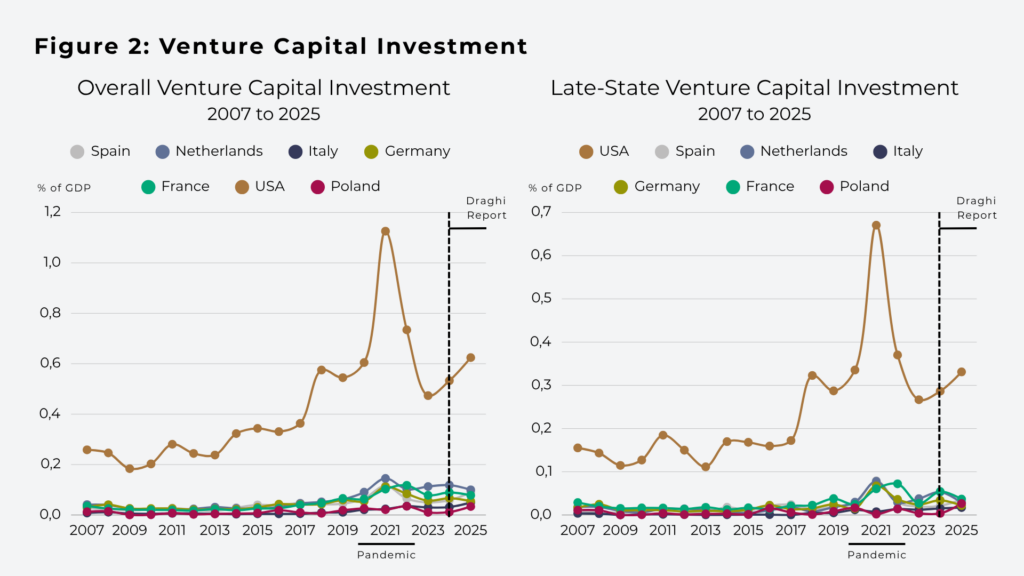
The OECD provides data for most of its member countries on VC investment as a percentage of GDP up to 2025: Figure 2 compares the US with the six largest EU economies both for total VC investment and for the portion devoted to late-stage ventures (where Draghi’s report suggests the EU is comparatively worse off).
This comparison is actually unfair to the US: since high-tech investments tend to concentrate in specific locations, the US average is a lot more diluted than, say, that of the Netherlands, which concentrates a lot of the research in the EU. Hence if, instead, we were to compare top EU countries with US states (California, Massachusetts…), the comparison would be even more lopsided in US favour.
Source: OECD
Yet the numbers speak for themselves. In the US (short of the statistically spurious peak in the 2020-2022 low-GDP post-pandemic years) VC investments in the US as a percentage of GDP are now at a record high, largely reflecting the AI boom. In Europe, conversely, neither the EC’s 2024 announcement of its adopting the Draghi report’s recommendations nor AI opportunities themselves seem to have caused any particular VC investment rush in 2025, so the ratio, with minor turns up and down in specific countries, has largely remained the same.
It is still early days, of course, but one may wonder why investors are not pre-positioning for the VC boom the new EC policy is meant to trigger. The explanation is of course the usual: they do not foresee any substantial change in the policies that most seriously hinder their appetite for investment in Europe. There is a saying among economic analysts: America invents, Asia produces, Europe regulates.
There is substantial evidence, both academic[xiv] and journalistic[xv], that over-interventionist EU-level regulation (not, mind you, the country-level “gold-plating” of it that the Draghi report so strenuously aimed to remove) is severely limiting the willingness of investors to develop and scale up innovations in Europe instead of moving them to the US. This should surprise no one: regulation per se is limiting and, in high-risk, high-reward, greenfield activities with few or no sunk costs tying the investment to a given place, such limitations all-too-often tip the balance against the EU.
To be sure, the EC as well as EU national governments can always attract investors by footing part of the bill of the investments they want to promote: this has already been done extensively in the past, and the Draghi report recommends to keep doing it, albeit also centralising it much more under the EC umbrella. Yet this is not differential respective to the US: the Draghi report itself (p. 237, Figure 9) highlights that the EU spends 0.74% of its GDP in public support to R&D, whilst the US spends just 0.65%. The Draghi report’s other proposed explanations, such as the higher degree of regulatory homogeneity across the US or the fact that most US public R&D spending is managed by the federal government (whereas most of the EU’s spending is decided at member state level), may be valid but simply cannot explain the colossal gap between EU and US VC investment. Regulatory overload is the obvious explanation… Yet Draghi’s recommendations, strong as they are in centralisation and EU-wide standardisation, are remarkably lame when it comes to deregulation.
The slippery slope ahead
This may indeed be the Draghi report’s true Achilles’ heel: not so much the slowness of its deployment, nor the compromises it has to make along the way, as its heavily interventionist outlook and its disregard for the core difference that explains the superior innovation performance of the US and even of some EU countries (e.g. the Nordics), let alone Switzerland: laissez-faire. This is particularly puzzling for those who remember how, until the dark days of the Eurozone crisis, the EC was strongly committed to EU liberalisation. Today, perhaps because that experience left behind a nagging fear among European elites that the EU’s social fabric and its voters might not tolerate another similar experience, this commitment to liberalisation seems less clear, and appears to have been replaced by the centralisation push we highlighted at the start of this paper[xvi].
Yet now it may also be a particularly unfortunate time to follow this approach. In 2003 Lester Thurow, a deeply Keynesian economic thinker, already noted that Europe had been slow to adopt the Third Industrial Revolution mostly due to its penchant for overregulation[xvii]. Now, for essentially the same reason, it seems about to miss the boat of the Fourth, which means that, if since 1990 its GDP per capita has been steadily falling behind that of the US, going forward this relative decline is likely to accelerate and, perhaps, even turn into absolute decline.
Sources: The Economist; IMF
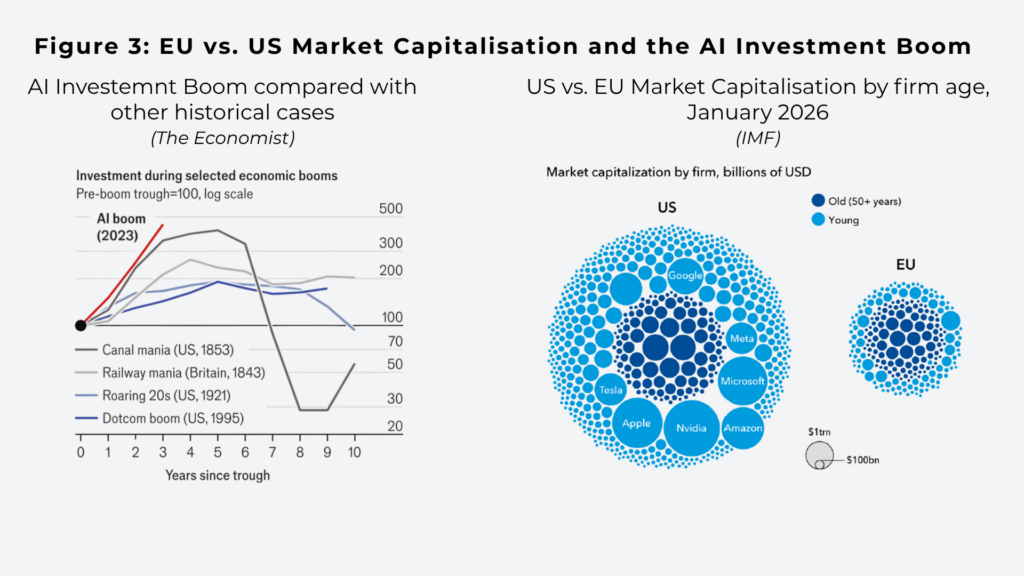
This is by no means scaremongering. The innovation gap with the US is real and growing but, until now, its growth has taken place at a slow, steady, frog-boiling rate. With Artificial Intelligence, the rate of relative decline is likely to accelerate. The US AI investment rates are exceeding those of every previous investment boom including the dot-com bubble that drove the IT and internet wave (Figure 3, left) —this explains why venture capital investment has been growing so fast for the last three years in the US… whilst in the EU they largely remain stuck.
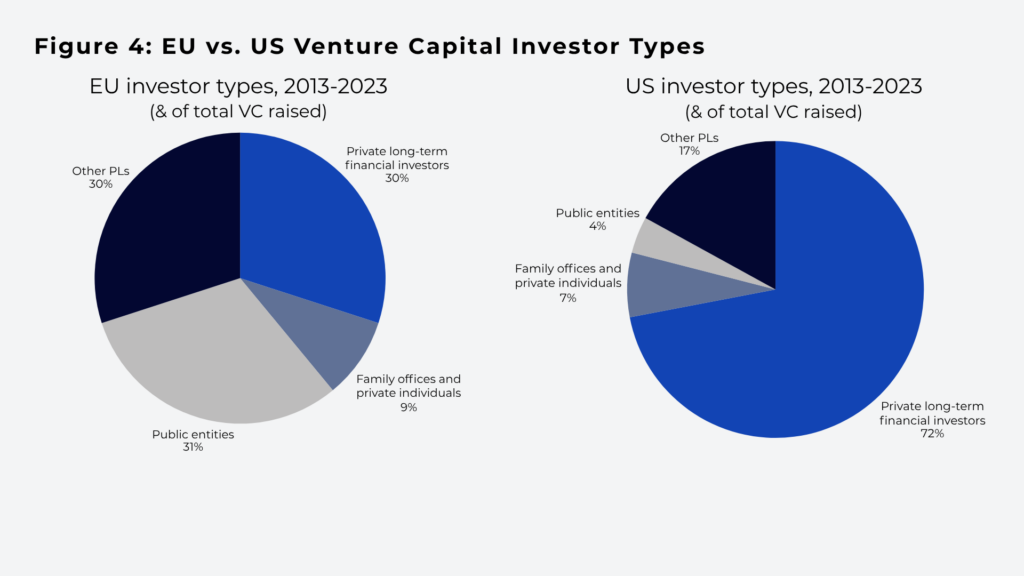
Furthermore, overall EU market capitalisation already starts at a much lower level than in the US, and the difference is essentially due to companies born less than 50 years ago (Figure 3, right), which suggests, if nothing else, lower business dynamism… And the fact (Figure 4) that 31% of EU VC investors are public entities (vs. barely 4% in the US) whereas only 30% are private long-term financial investors in the EU (vs. 72% in the US) strongly suggests that the most aggressively mobile, return-seeking investors place their bets in the US, whereas location-bound investors stay in the EU because it is institutionally more difficult for them to move out[xviii]. The Draghi report’s recommendations may certainly help to mitigate the EU’s backward slide, but it does not seem geared or even conceived to close this gap, let alone reverse it.
Sources: Pitchbook Data Inc.; IMF calculations
Draghi’s two other main goals (cheap energy and defence) are, by the report’s own account, less critical and, at the same time, offer fewer lead indicators that, like VC for innovation, we could reliably use just two years after the report itself was issued: defence and, even more, energy investment often have notoriously long lead times. As we saw before, however (Figure 1), the Energy recommendations’ degree of completion (21.7%, of which a mere 1.2% are fully implemented while the rest are partially deployed) is the lowest of all: ironically, environmental initiatives (which are arguably parallel but not core to the cheap energy goal), seem to be substantially further ahead. Only Defence appears to be making significant progress, obviously propelled by the geopolitical considerations newspapers highlight every day.
Two years ago, when commenting on Draghi’s report and the EU’s competitiveness challenges[xix], I advanced the hypothesis that the EU might be on course to become something akin to Italy after unification (a scenario that, borrowing from a Morgan Stanley report, I referred to as “Matrimonio all’Italiana”). This entails a tighter fiscal/political Union on top of an increasingly divergent economic landscape, thus leading to political pressure for growing fiscal transfers (at the expense of economic performance) for the sake of social cohesion. The Draghi report’s penchant for centralisation and disregard for institutional quality drove the Union faster along the road towards that Italian scenario. If, in addition, its recommendations do not prevent the EU’s competitiveness gap from widening even further, as it looks so far increasingly unlikely that they will (particularly as AI is set to change the rules of the game), the future may soon enough bring widespread economic and social decline across Europe. This is the slippery slope down which Europe seemed to be sliding two years ago and, sadly, appears to be sliding even faster today.
[i] European Commission. (2024). The future of European competitiveness: A competitiveness strategy for Europe. https://commission.europa.eu/topics/competitiveness/draghi-report_en
[ii] See, for example, Gros, D. (2024, October 2). Draghi report on Europe’s competitiveness falls short. POLITICO. https://www.politico.eu/article/mario-draghi-report-european-competitiveness-common-debt-innovation/, Pelkmans, J. (2024). A critical first response to Mario Draghi’s competitiveness report. Centre for European Policy Studies. https://www.ceps.eu/ceps-publications/a-critical-first-response-to-mario-draghis-competitiveness-report/ and McCann, P. (2025). Some observations on the Draghi report on the future of European competitiveness. Scienze Regionali, 24(1), 17–24. https://ideas.repec.org/a/mul/j9qko3/doi10.14650-116133y2025i1p17-24.html as well as my own paper Gracia, E. (2025). Where Draghi’s report missed the plot: Europe’s great degeneration on the eve of Trump’s second coming. Catalonia Global Institute. https://cataloniaglobal.cat/en/where-draghis-report-missed-the-plot-europes-great-degeneration-on-the-eve-of-trumps-second-coming/
[iii] See Bulgarian News Agency. (2026, March 2). Bulgaria in European Public Prosecutor’s Office Report 2025: 82 fraud investigations with estimated damage of EUR 702 million. BTA. https://www.bta.bg/en/news/1075353-bulgaria-in-european-public-prosecutor-s-office-report-2025-82-fraud-investigat and European Anti-Fraud Office. (2025, February 11). OLAF plays pivotal role in uncovering 100 million EUR suspected subsidy fraud with links to organised crime. https://anti-fraud.ec.europa.eu/media-corner/news/olaf-plays-pivotal-role-uncovering-100-million-eur-suspected-subsidy-fraud-links-organised-crime-2025-02-11_en
[iv] Gill, I., & Raiser, M. (2012). Golden growth: Restoring the lustre of the European economic model. World Bank. https://www.worldbank.org/en/region/eca/publication/golden-growth
[v] Schwab, K., et al. (2014). The Europe 2020 competitiveness report: Building a more competitive Europe. World Economic Forum. https://www3.weforum.org/docs/WEF_Europe2020_CompetitivenessReport_2014.pdf
[vi] Faggionato, G., & von der Burchard, H. (2024, September 9). Germany’s Lindner rejects Draghi’s common borrowing proposal. POLITICO. https://www.politico.eu/article/germanys-lindner-rejects-draghis-common-borrowing-proposal/
[vii] European Commission. (2025). One year after the Draghi report. https://commission.europa.eu/topics/competitiveness/draghi-report/one-year-after_en
[viii] DraghiWatch. (2026). Draghi Implementation Index: July 2026 update. https://draghiwatch.eu/
[ix] European Commission. (2025). SAFE. https://commission.europa.eu/strategy-and-policy/eu-budget/eu-borrower-investor-relations/safe_en
[x] European Commission. (2025). Clean Industrial Deal. https://commission.europa.eu/topics/competitiveness/clean-industrial-deal_en
[xi] European Commission. (2025). AI Continent. https://commission.europa.eu/topics/competitiveness/ai-continent_en
[xii] European Commission. (2026). EU invests over €307 million in artificial intelligence and related technologies. Shaping Europe’s Digital Future. https://digital-strategy.ec.europa.eu/en/news/eu-invests-over-eu307-million-artificial-intelligence-and-related-technologies
[xiii]London Stock Exchange. (n.d.). Historic statistics pre 2005. https://docs.londonstockexchange.com/sites/default/files/reports/Historic%20Statistics%20Pre%202005.pdf
[xiv] Jia, J., Jin, G. Z., Leccese, M., & Wagman, L. (2025). How does privacy regulation affect transatlantic venture investment? Evidence from GDPR (NBER Working Paper No. 33909). National Bureau of Economic Research. https://www.nber.org/papers/w33909
[xv] Bhutani, A. (2025, October 4). Europe’s AI startups look stateside for bigger checks, quicker deals. The Wall Street Journal. https://www.wsj.com/tech/ai/europes-ai-startups-look-stateside-for-bigger-checks-quicker-deals-1a1dff43?utm_source=chatgpt.com
[xvi] See, for example, Schmitz, L., & Seidl, T. (2023). As open as possible, as autonomous as necessary: Understanding the rise of open strategic autonomy in EU trade policy. Journal of Common Market Studies, 61(3), 834–852. https://onlinelibrary.wiley.com/doi/full/10.1111/jcms.13428?utm_source=chatgpt.com and Di Carlo, D., McNamara, K. R., & Moschella, M. (2026). The new politics of EU industrial policy: From the regulatory state to a transformational state. Governance, 39(3), e70133. https://onlinelibrary.wiley.com/doi/full/10.1111/gove.70133?utm_source=chatgpt.com
[xvii] As quoted in Where Draghi’s report missed the plot: Europe’s great degeneration on the eve of Trump’s second coming. Catalonia Global Institute. https://cataloniaglobal.cat/en/where-draghis-report-missed-the-plot-europes-great-degeneration-on-the-eve-of-trumps-second-coming/
[xviii] Arnold, N. G., Claveres, G., & Frie, J. (2024). Stepping up venture capital to finance innovation in Europe (IMF Working Paper No. 2024/146). International Monetary Fund. https://www.imf.org/en/publications/wp/issues/2024/07/10/stepping-up-venture-capital-to-finance-innovation-in-europe-551411
[xix] Where Draghi’s report missed the plot: Europe’s great degeneration on the eve of Trump’s second coming. Catalonia Global Institute. https://cataloniaglobal.cat/en/where-draghis-report-missed-the-plot-europes-great-degeneration-on-the-eve-of-trumps-second-coming/
Eduard Gracia is an economist and MBA, as well as author of several books and articles about economic topics. For nearly three decades he worked as a management consultant based first in New York, then London and finally Dubai. He is currently a lecturer of international economics at the University of Barcelona.
The opinions expressed in this publication are those of the authors. They do not purport to reflect the opinions or views of the CGI or its contributors. The designations employed in this publication and the presentation of material therein do not imply the expression of any opinion whatsoever on the part of the CGI concerning the legal status of any country, area or territory or of its authorities, or concerning the delimitation of its frontiers.