The Second China Shock: causes and consequences of a global economic transformation
30/10/2026
You can download the PDF version HERE.
Executive Summary
This article analyzes the Second China Shock, characterized by a surge in Chinese exports of high-value-added goods and the country’s enormous trade surplus. The phenomenon is the result of a growth model built on very high savings, weak domestic demand, heavy investment and an industrial policy aimed at strategic sectors. The outcome is an economy with internal imbalances that exports vast manufacturing overcapacity, causing deindustrialization and geopolitical tensions in the rest of the world. Faced with this situation, the major economies have three options: rebalance in a coordinated way, maintain the status quo, or brace for a new crisis.
Introduction
During the nineties and first decade of the 21st century, China’s rise was one of the main engines of globalization. As Western industry relocated part of its production to the Asian country, millions of Chinese products reached markets around the world. The underlying idea was that China would Westernize, both politically, toward democracy, and economically.
Today, those ideas look like the products of a naive worldview. China has become a technological, economic and military superpower locked in a Second Cold War with the United States. In 2025, for the first time in history, China’s trade surplus exceeded $1 trillion. Its exports to Africa grew by 25.8%, to ASEAN countries by 13.4%, and to the EU by 8.4%[i]. Yet these figures, which lead to unprecedented economic power, conceal an uncomfortable reality. China’s economy has had serious problems since 2021, when the crisis in the property sector began. Although reliable data are hard to come by, youth unemployment has climbed this year to 17.9%[ii] and there are doubts about the growth figures[iii].
This is the great paradox this article addresses: how can an economy with serious internal imbalances generate the largest trade surplus in history? The answer lies in what some experts have called the Second China Shock. The article begins by explaining the Second China Shock and its impact. It then analyzes the factors that brought us here, from China’s growth model and industrial policy to currency manipulation. Finally, it lays out the three future scenarios: reform, stagnation or global crisis.
The Second China Shock
In the 2010s, the term China Shock came to refer to the economic effects, above all in the US, of China’s accession to the World Trade Organization (WTO) in 2001. The story of the shock is well known. China’s opening to the world set off two phenomena: first, a massive influx of highly cost-competitive manufactured goods that pushed many firms out of the market and, second, the offshoring of Western industries to China. This surge in Chinese exports rested mainly on low-value-added goods produced with relatively low wages. Textiles, toys and footwear are the classic examples.
This influx of goods brought an enormous short-term benefit to the vast majority of consumers worldwide, who could buy products at far lower prices, but it had lasting negative effects on many manufacturing regions and communities in the US and elsewhere. The shock is estimated to have cost between 2 and 2.4 million jobs[iv], something significant but not devastating for the American labor market. Even so, the standard narrative holds that those Rust Belt communities became the seedbed of much of the cultural resentment and economic stagnation that characterize the so-called “losers of globalization,” who are said to have voted for Trump in 2016 as a protest against the “globalist elites.”
The Second China Shock (China Shock 2.0) has little to do with the first and tells a different story. Whereas the first shock centered on low-value-added manufacturing sectors that paid low wages, the second is characterized by a very sharp rise in exports of high-value-added technology products to the rest of the world. The first shock, although extraordinary in scale, fit the predictions of economic theory and was accompanied by a rise in Chinese imports. That parallel rise in imports benefited countries such as Germany, which supplied Chinese industry with technological and chemical products. Today we are also seeing exports grow, but imports are growing at a much slower pace, and the prices of Chinese products keep falling. This displaces mid-sized and large firms, many of them European, that cannot compete with Chinese products on neither price nor quality. The visible result is a rising Chinese trade surplus (the difference between exports and imports), which has climbed to an all-time high of $1.2 trillion.
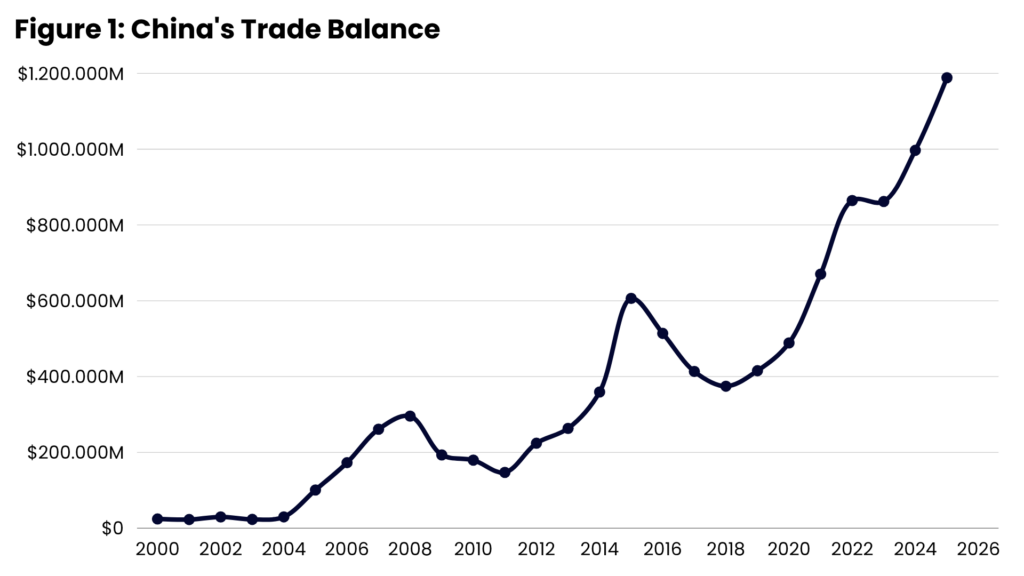
Source: OECD, via FRED®
This increase is worrying for three reasons. First, the macroeconomic imbalances at the heart of the shock raise the risk of a global crisis. Every surplus implies a deficit. If one country exports more, another country must necessarily be absorbing those goods and running larger deficits. Countries that import more than they export—those with trade deficits—need capital inflows to pay for their imports. Economic imbalances are normal and healthy, but when they are very large and persist over the long term, the accumulation of liabilities—mainly debt—ends up increasing the financial risks faced by the countries that receive the exports. Over recent decades, the US has run large trade and fiscal deficits, absorbing foreign goods and capital. In August 2026, US debt exceeded $40 trillion, and rising financing costs are starting to cause concern. Most recent episodes of large global trade imbalances have ended in financial crises.
Second, a massive influx of products can destroy much of a country’s industrial base. That is not only a matter of jobs: the destruction of advanced industry would reduce a society’s capacity for innovation and its economic resilience. Third, there are geopolitical concerns. Some estimates project that by 2030 China will account for 40% of global manufacturing output[v]. China already controls much of the supply chain for critical minerals, rare earths and renewable energy; greater dependence in increasingly advanced industrial sectors could give Beijing unprecedented geoeconomic power. A growing share of the world’s productive capacity would thus be concentrated in a single country, increasing the vulnerability of the rest of the world to possible trade disruptions or political decisions by Chinese officials.
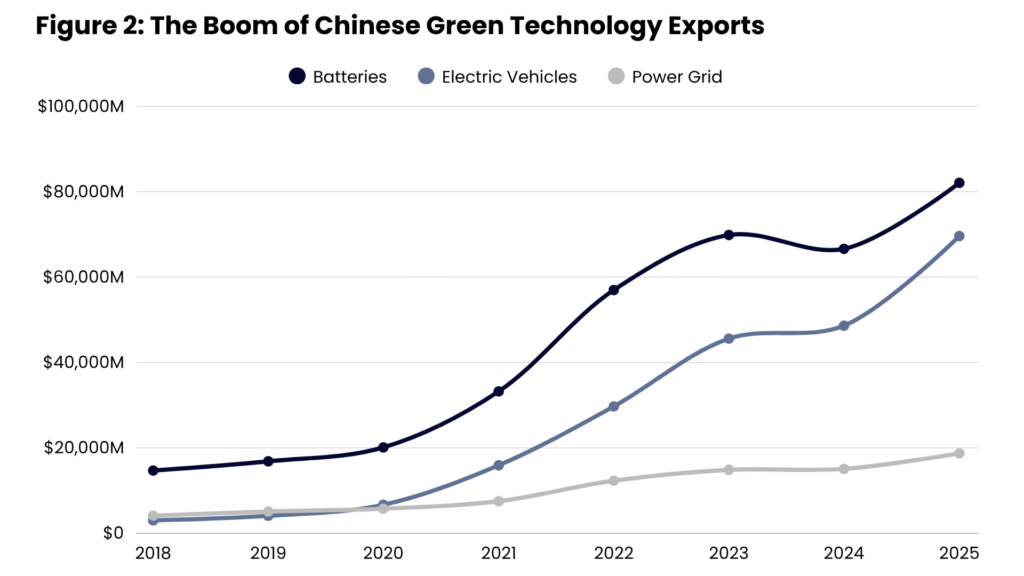
Source: China Cleantech Data – Ember
Although much of China’s past growth came from imitating its competitors (catch-up growth), its current development cannot be understood from that perspective. Predictions that China would get stuck in a middle-income trap, unable to innovate and outproduce its competitors, have been proven wrong. This is problematic not only geopolitically but also democratically. The second shock contradicts all those theories that link economic growth and innovation to inclusive institutions, usually associated with liberal democracies. The big question, then, is how we got here and, above all, what should be done.
The Causes of the Second China Shock: China’s Political Economy
Many economic, political and social variables, often interacting in complex ways, lie behind the shock. The most immediate causes, however, are simple: between 2018 and 2020, many Chinese firms in high-value-added manufacturing sectors became far more competitive, not only on cost, with cheaper products, but also in technological sophistication and innovation. There are many sector-specific stories here, and paradigmatic cases include China’s electric vehicle, solar panel and electric battery industries, but the impact goes well beyond these more high-profile products.
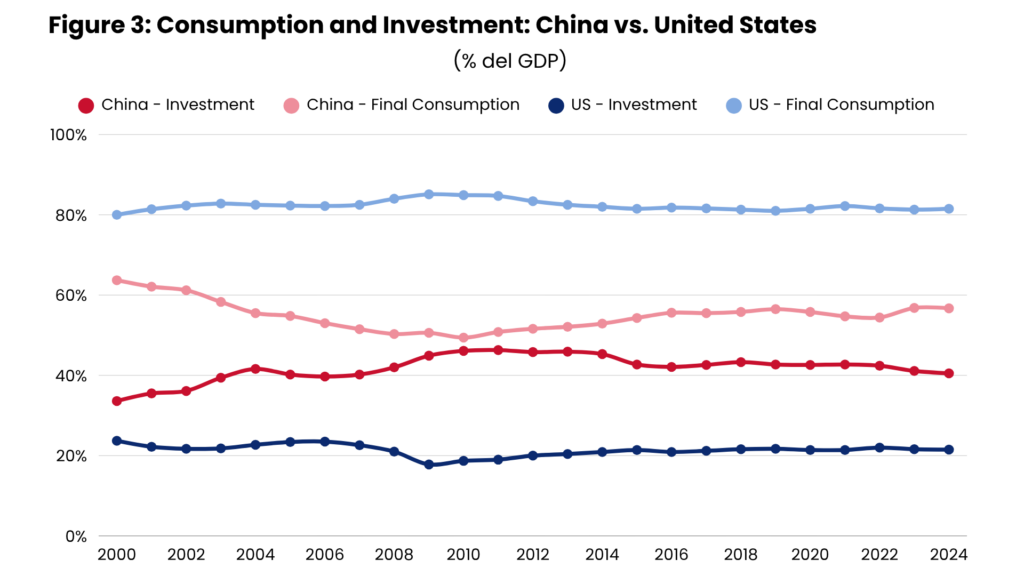
To understand the reasons behind this phenomenon, we must first understand the basis of China’s growth model. It rests on a sharp imbalance between society’s savings and consumption. Looking at the Chinese economy in aggregate, we see that it has one of the highest savings rates in the world, whereas the US is a country with very high levels of consumption. This disproportionate tilt of income toward savings is deliberate and engineered through labor and fiscal policies that suppress domestic demand. Although Chinese wages have grown (a lot) in recent years, they have grown at a slower rate than productivity. Add to that a very thin welfare state that forces families to save for a safety net, adverse demographic prospects, and very low interest rates on deposits, and the result is that China consumes very little and saves a great deal.
Source: World Development Indicators – World Bank
Second, there is Chinese industrial policy. These savings, which accumulate in a financial system tightly controlled by the state, have to go somewhere. Here the second element of the Chinese model comes in: an extraordinarily high investment rate, sustained for decades. At first, this investment went mainly into public infrastructure: China’s great bridges and the world’s most extensive high-speed rail network. Later, investment shifted into real estate, which for years was one of the main engines of Chinese growth. That phase, however, reached its limit with the housing market crisis that began in 2021. China thus found itself with an economy that still had a very high savings rate but fewer investment opportunities, and with domestic consumption falling because of the property crisis.
It is in this context that investment has increasingly shifted toward manufacturing. Initiatives such as Made in China 2025, under the 13th Five-Year Plan, identified manufacturing sectors considered strategic, such as electric vehicles, batteries and renewable energy. Two reactions follow. First, China’s state-controlled financial system begins channeling capital massively toward the sectors the authorities have prioritized, at very low interest rates. Second, local governments, which are responsible for implementing the central government’s objectives, compete with one another to attract firms in strategic sectors through direct and indirect subsidies—free land grants, for example. This situation produces what is known in China as involution (neijuan): firms competing aggressively against one another, often through price wars, long working hours and shrinking profit margins. The result is an enormous expansion of industrial capacity that grows far faster than the domestic demand of a Chinese market unable to absorb the output (overcapacity), yet which cannot stop without triggering a crisis. This process, which is unfolding in sectors such as electric vehicles, batteries, solar panels and other advanced technologies, is a way of exporting the country’s internal imbalances to the rest of the world.
The third key factor is currency manipulation. Any economics textbook explains that, under stable conditions, when a country increases its exports, demand for its currency rises. That higher demand would make the currency appreciate—that is, it would cost more euros to buy a yuan—and Chinese products would therefore become more expensive for foreign consumers. The underlying idea is that a rise in exports will eventually trigger a reaction in the foreign exchange market that, over the long term, returns the economy to equilibrium. Since the 2000s, multiple international institutions have pointed out that China intervenes in the currency market to keep the renminbi from appreciating, thereby limiting the effect a growing external surplus would have on its competitiveness. Brad Setser and Shahin Vallée argue that these efforts have multiplied since the Second China Shock began. To disguise these interventions, state banks are said to be buying foreign currency and holding it outside the central bank’s official reserves. The result would be a yuan undervalued by 30%[vi].
Reform, Stagnation or Crisis
The result of this process is an economy that exports its internal imbalances abroad. This pattern, seen throughout history with many great powers, is today, together with the race for artificial intelligence, one of the main fronts of global economic and geopolitical competition.
Both China and Europe face major contradictions. On the one hand, China needs manufacturing exports as its last remaining source of growth if it wants to avoid rising unemployment and social discontent. These exports also secure control over value chains that are critical to geopolitics and the global economy. On the other hand, the surplus causes serious diplomatic problems with many countries which, if they moved into more severe protectionist phases, could end China’s growth model. For its part, if the European Union took a protectionist turn, it would not only face a trade crisis but would also be giving up both the Chinese products essential to the energy transition and its identity as a defender of a rules-based international order. If it does not, however, it risks losing much of its industrial base, with the political and economic consequences that would entail.
Faced with this situation, there are three possibilities. The first is the most optimistic and, at the same time, the least likely: a coordinated rebalancing of the imbalances. Reports from the IMF[vii], G7[viii] and numerous experts[ix] point in this direction. In this scenario, China would have to boost domestic demand by strengthening its welfare state, which could be financed, in part, by cutting industrial subsidies. It would have to shift part of its savings out of the manufacturing sector, which suffers from overcapacity, and into more productive uses, such as urban renewal or investment in public services. Another option would be for it to open its currency market and allow the renminbi (yuan) to appreciate. The US, hence, would need to move toward fiscal consolidation and higher national savings, cutting its public deficit and moderating consumption. The EU, on its part, would need to increase public investment to strengthen its productive capacity.
A second option is the status quo. In this scenario, none of the major economies agrees to bear the full cost of adjustment. China keeps its growth model and tries to preserve its surpluses by expanding exports. The US tries to cut its deficit through tariffs, industrial policy and trade restrictions, but without substantially altering the imbalances at the root of the problem. The European Union is caught between the two blocs: it may reach partial trade agreements with China and introduce some tariffs or defensive measures, but without a substantively coordinated industrial and trade policy to reverse the trend.
The last option is a crisis. In the long run, large economic imbalances do get adjusted, although it is unclear on whom the greatest impact will fall. If China cannot keep exporting its surpluses and is also unable to raise domestic consumption enough, the contraction could trigger a domestic economic crisis, with higher unemployment and financial problems. If the US tries to maintain its level of consumption without being able to keep financing it with foreign capital inflows, the adjustment could come through a debt crisis. And if Europe keeps absorbing the surpluses that the US is no longer willing to absorb, the cost could show up as deindustrialization, slower growth and rising debt.
History does not allow us to predict how the Second China Shock will end. Sooner or later, though, someone will have to bear the cost. The question is whether the major economies will be able to coordinate a gradual rebalancing or whether we are doomed to another crisis
References
[i] Cash, J., & Chen, X. (2026, January 14). China’s trade ends 2025 with record $1.2 trillion surplus despite Trump Tariff jolt. Reuters. https://www.reuters.com/world/china/chinas-trade-ends-2025-with-record-trillion-dollar-surplus-despite-trump-tariffs-2026-01-14/
[ii] Wang, S. (2026, August 19). Record graduate influx lifts China’s youth jobless rate to 17.9% in july. South China Morning Post. https://www.scmp.com/economy/china-economy/article/3364538/record-graduate-influx-lifts-chinas-youth-jobless-rate-179-july
[iii] Ip, G. (2024, March 6). Why you shouldn’t trust China’s growth data. The Wall Street Journal. WSJ. https://www.wsj.com/world/china/why-you-shouldnt-trust-chinese-growth-data-c65d1a8c
[iv] Acemoglu, D., Autor, D., Dorn, D., Hanson, G. H., & Price, B. (2015). Import competition and the great US employment sag of the 2000s. Journal of Labor Economics, 34(S1), S141–S198. https://doi.org/10.1086/682384
[v] Tordoir, S., & Setser, B. (2026). China shock 2.0: the cost of Germany’s complacency. In Centre for European Reform. https://www.cer.eu/publications/archive/policy-brief/2026/china-shock-20-cost-germanys-complacency
[vi] Setser, B., & Shahin Vallée. (2026, June 11). The Real Problem With Global Trade. Foreign Affairs. https://www.foreignaffairs.com/china/real-problem-global-trade
[vii] International Monetary Fund. (2026). Understanding Global Imbalances. Policy Papers, 2026(006). https://doi.org/10.5089/9781484335956.007
[viii] Chong-En Bai, Gopinath, G., Rey, H., & Weber, A. (2026, March 28). G7 Economists Memo on Global Imbalances. Elysee.Fr. https://www.elysee.fr/en/G7evian/2026/03/30/g7-economists-memo-on-global-imbalances
[ix] di Mauro, B. W., & Zettelmeyer, J. (2026, April 13). The new global imbalances: Why care, why now and what should be done? Bruegel. https://www.bruegel.org/essay/new-global-imbalances-why-care-why-now-and-what-should-be-done
Martí Serra Figarola holds a degree in Philosophy, Politics, and Economics (PPE) from Pompeu Fabra University and a master’s degree in European Affairs from Sciences Po Paris. He is currently a Marie Skłodowska-Curie predoctoral researcher at the University of Bristol, where he studies the European Union’s geoeconomic turn, and a visiting researcher at the Diplomatic Academy of Vienna.
The opinions expressed in this publication are those of the authors. They do not purport to reflect the opinions or views of the CGI or its contributors. The designations employed in this publication and the presentation of material therein do not imply the expression of any opinion whatsoever on the part of the CGI concerning the legal status of any country, area or territory or of its authorities, or concerning the delimitation of its frontiers.