The Taiwan Dome (T-Dome) and the challenging Astropolitics behind it
25/05/2026
Abstract
Taiwan and its defence industry have decided to make a step forward announcing of a multilayer missile defence system called the T-Dome. As the name suggest, it has been inspired by the Israeli Iron dome. But the military, political and geographical differences between Israel, Taiwan and their adversaries are enormous.
Even though the Taiwanese defence and space industries have shown strengths, a multilayer missile defence system of such characteristics will face several (and big) challenges.
The present article wants to discuss such challenges and the learnings other political actors, including Catalonia, could take from the T-Dome project and the Taiwanese defence and space sectors.
T-Dome an update to current antimissile capabilities already falling short?
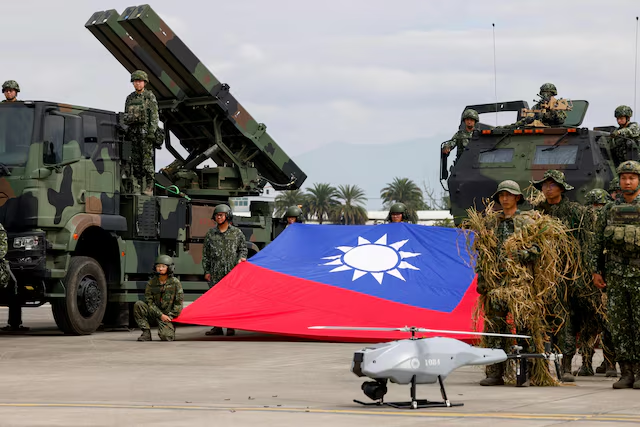
Last October, Taiwan President Lai Ching-te announced plans to build a new multi-layered missile defence network called Taiwan Dome (T-Dome) to protect the island from mainland China´s threats. Israel’s Iron Dome and the projected Golden Dome in the U.S. are the obvious references.
Certainly Mainland China did not receive well the announcement making Taiwan’s threat environment very different to the ones of Israel or the U.S. In fact, it is way more complicated than both. The T-Dome is not something Taiwan can buy from those countries but rather something it needs to engineer to its own specific needs.
Mainland China is the world´s second economy and military power, has a population of 1.4 billion people and is barely a hundred miles away from Taiwan. It can mount a coordinated, largescale strike that combines ballistic and cruise missiles, long-range rockets, hypersonic systems, glide munitions, crewed aircraft, and massed unmanned platforms. These strike assets can be paired with space-based surveillance, electronic warfare, and cyber operations to form an integrated campaign. Taiwan, with a population of 23 million people and limited strategic depth and extremely short warning times, would confront a level of scale, integration, and technological sophistication far beyond anything that Israel’s adversaries can field, including Iran´s advanced rocket and drone programs. Finally, the T-Dome would need not just to protect the population and the military assets of Taiwan but also its semiconductor industry and that´s not a small challenge.
The Iron Dome was designed to protect Israel from rocket and missile launches from neighbouring countries and territories by using radars and intercepting rockets. However, ground-based radar systems, while extremely powerful, often detect missiles only after they rise above the horizon. This creates a delay in early warning and reduces the time available for interception. Early missile warning through infrared technology in satellites can solve this issue and that is why the U.S. equivalent, the Golden Dome, will incorporate them as an extra layer of defence inside the system.
Space-based infrared sensors can detect the heat plume of a missile launch almost immediately. That difference of minutes, or even seconds, can determine whether a missile is successfully intercepted. Radars cannot detect missiles until they rise above the earth curvature, but satellites can monitor larger regions and complement radar networks overwhelmed by multiple launches.
Last but not least, radars have difficulties tracking hypersonic missiles. Mainland China already has one of the world’s most advanced hypersonic weapons programs, combining extreme speed (above Mach 5), long range (up to 2,500 km), and manoeuvrability that makes these systems very difficult to intercept or even detect. In fact, recent analyses point that Mainland China is ahead of the U.S. and Europe in operational deployment, with systems like the DF17 and DFZF already fielded. The push to obtain these systems has been precisely to strengthen Mainland China´s ability to deter U.S. intervention around Taiwan and the South and East China seas. And that is the main reason why the U.S. will include a layer of satellites in its Golden Dome. Even though China has tested anti-satellite weapons, proliferated constellations of several satellites mitigate this risk by making it harder for adversaries, including superpowers, to disable entire systems.
The Astropolitcs of anti-missile defence systems in Taiwan
So, will the T-Dome project include a layer of satellites to its system? So far that has not confirmed but it might become a necessity. Still, including them might challenging for a number of reasons.
Even though Taiwan could potentially buy elements from American companies, such as Raytheon Technologies or Teledyne Technologies, developing infrared sensors for satellites, the politics behind acquiring them can be quite sensitive. That would be, not just because the U.S. might veto the technology export to keep the defence edge, but also to avoid direct retaliation from Mainland China. Could Taiwan develop the necessarily technologies natively then?
Former Taiwan president Tsai Ing-wen proposed in 2021 for Taiwan to have a strategic position in the space sector by having its own space program. De facto that is already happening through its semiconductor but also satellite components industry. Starlink satellites have already plenty of parts from Taiwanese firms, like Chin’Poon Industrial or Universal NeWeb Corporation, showing Taiwan clear intention to cement its position in the satellite global supply chain. The issue is that Space X already asked these companies to move manufacturing to Thailand and Vietnam to diversify production. The geopolitical risk is quite obvious for American firms.
Still, defence satellites for the T-Dome are still a possibility.
Taiwan launched its first satellite back in 1999 and created his own space agency back in 1991 as National Space Organization (NSPO) reformulating it as Taiwan Space Agency (TASA) in 2023. During the same year, the Space Development Act became operational. This Act is the island’s foundational legal framework for governing space activities, shaping its emerging space industry, and aligning local ambitions with international norms. It represents a major step in Taiwan’s transition from a research driven space program to a full-fledged strategic sector. Taiwan geopolitical intentions seem quite clear.
In 2017 Taiwan launched its first domestically developed satellite producing images for dual use (civil and defence) and it’s also aiming a big push in low earth orbit satellite communications by having its also own double use constellation by 2030 at an estimated cost of NT$27 billions or €728 milions. Currently Taiwan is connected to the Internet through submarine cables, that´s why both public and private sectors are looking for a satellite constellation to add resilience to the current internet network. At the same time, Taiwan wants to avoid Ukraine type scenarios where the country under attack requires foreign commercial assistance (Starlink) to keep civil and defence communications afloat.
Another challenge would come from launching those satellites. Even though Taiwan has a national launch centre in Pingtung County’s Syuhai Village and research institutions have successfully launched suborbital rockets, launching satellites natively it´s a different matter, both technologically and politically. Even though the intention is to grow the rockets and the testing ground, the international political backlash could be substantial. Mainland China can understand a bigger rocket as a long-range missile aiming at its capital. Even the U.S., the guarantor of Taiwan´s self-governance, could torpedo that option considering Mainland China retaliation too risky for its own interests. Would the U.S, launch those satellites instead? We could consider that an open question.
Furthermore, there´s the challenge of the cost. During the time of the T-Dome announcement, President Lai Ching-te also announced that Taiwan must increase its defence spending from 3% of GDP to nearly 5% by 2030. That would be around €40 billion, not small numbers. Adding a satellite layer (and the ground and cybersecurity infrastructure supporting it) to the T-Dome anti-missile defence system would increase the financial pressure on the national budget even more.
Several years and billions of euros were invested in the creation of Israel´s Iron Dome (not using satellites currently) and in times of war, like the current one, the estimate is that hundreds of millions of euros will be used operating it. Can Taiwan afford that? can its defence and space industries and their supply chains provide for that?
Lessons for other political actors, including Catalonia
As we have seen the creation of an anti-missile multilayer dome presents several challenges, not just technological but also economic and political. That in itself is a lesson to take, satellites and rockets are double use technologies. A satellite can send pictures of a fire in a forest but also of enemy assets, it can geolocate your date on Tinder but also your troops and it can allow you to watch YouTube in a mountain shelter but also reconnect your government online if it the enemy cuts Internet cable communications during an attack.
Same with rockets; they can bring these satellites to space but also become long range missiles. That is why space technologies aren’t just difficult and expensive; they are very sensitive politically speaking. And we are not talking just about technological transfer; even native technologies interfere in geopolitics when they reach the outer space surrounding the planet.
And finally, there is the cost. Even though commercial space has made space technologies cheaper than ever before, launching things into space it is still very difficult, therefore not cheap. In a time where industrial truths about the economic costs of fighting a war are being rediscovered both in Ukraine and Iran, long term affordability is not a small issue when developing a defence system.
Still, the cards of the geopolitical world are being reshuffled among players, and an increasing number of them are taking the risks to achieve sovereign access to space.
Even space commercial companies like Space X or Rocket Lab are trying to integrate their supply chains to become more sovereign. Space is not just a matter of political prestige, is becoming increasingly an unmissable asset for defence. We are witnessing that not just in Ukraine where Starlink helped reconnecting the country to the Internet but also in Iran. Some analysts claim that Russia is providing imaging and China is providing geolocational through satellites to help the Persian country fight the U.S. and Israel.
Catalonia, currently an autonomous nationality inside Spain, could take notes as well. Catalonia, like Taiwan, has also a Space Agency called the IEEC (Institut d’Estudis Espacials de Catalunya – Institute of Space Studies of Catalonia) created even before the Taiwanese one, back in 1996. The Catalan Government has launched three imaging satellites and is on the way to launch a 6G experimental satellite made locally with native technology that would be tracked also from Catalonia. Similarly to Taiwan, Catalonia it’s developing its space and semiconductor industries to achieve strategic leverage at a European level in this case. The lessons that Catalonia can learn from Taiwan are in the scale. Taiwan is a de facto an international political actor not just because of geography but because of the size of its semiconductor industry and how it is directly connected to its space industry. The two of them are intertwined and very intentionally. The western world not just wants Taiwan´s semiconductors, it needs them. Similarly, the world´s leading space power, the US, needs Taiwan´s semiconductors and satellite components.
A direct comparison between the two territories is quite a difficult task. Taiwan´s population and GDP almost triples the one of Catalonia, and Taiwan is de facto a self-governing country with an army. However, Catalonia has its own cards to play. It has a dynamic cybersecurity sector, a small but growing public and private space sectors and it is part of an economic area of 450 million people with a staggering GDP of €27 trillion eager to invest precisely in semiconductor and space industries. Therefore, the main thing that Catalonia can learn from Taiwan is its focused and sustained political will for their semiconductor and space industry to straighten its geopolitical leverage.
Catalonia might not need to quest for a satellite layered antimissile system, but it identifies good opportunities in the space defence sector as its own Catalonia Space Strategy 2030 remarks. However, similarly to other European nationalities, there are quite a few PowerPoints, strategies and white papers on space and defence but not enough investment nor executive speed for these plans to achieve their goals and have an impact internationally.
We hope that the recent announcement of an exchange agreement between the IEEC and Taiwan’s most important technological competition, Mobileheroes, not just strengthens the connection between the Catalan space ecosystem and the Taiwanese telecommunications ecosystem but also teaches Catalonia a bit of Taiwan´s geopolitical know how and sustained will.
Marçal Sanmartí is an Astropolitics Analyst and member of the Planetary Society.
—-
The opinions expressed in this publication are those of the authors. They do not purport to reflect the opinions or views of the CGI or its contributors. The designations employed in this publication and the presentation of material therein do not imply the expression of any opinion whatsoever on the part of the CGI concerning the legal status of any country, area or territory or of its authorities, or concerning the delimitation of its frontiers.